BCP helps keep business processes active during incidents, while DRP ensures that data and systems can be restored quickly. The combination of the two is an important element for organizations that want to maintain operational stability in the digital age.
Read also: Corporate Data Leaks: A Real Threat to Business and How to Prevent Them
Understanding the Differences Between BCP and DRP in Modern IT Strategies
Business Continuity Plan focuses on how to keep business running when disruptions occur. It includes processes, procedures, and technologies that ensure services remain available to customers.
On the other hand, a Disaster Recovery Plan focuses on restoring IT systems, including servers, applications, and data. A DRP ensures that after a disruption occurs, the company can resume operations with minimal downtime.
When these two strategies are implemented simultaneously, companies are not only prepared to face disruptions but also able to manage risks in a more structured manner.
Challenges Often Faced by Companies Without a BCP and DRP Strategy
Many businesses still rely on manual backups or inflexible on-premise systems. This approach often presents various risks, such as:
- Time-consuming recovery processes
- Downtime that impacts customer service
- High infrastructure costs
- Lack of real-time security monitoring
Without the right strategy, even a minor incident can disrupt operations extensively and affect the company’s reputation.
The Role of Cloud in Optimizing BCP and DRP
Cloud technology provides a more modern approach to business continuity implementation. Through automatic data replication and cloud-based recovery systems, companies can restore services without having to rebuild their infrastructure from scratch.
Cloud solutions enable:
- Scheduled backup and data replication
- Quick server recovery
- Scalability according to business needs
- Centralized monitoring system
With this approach, BCP and DRP strategies are no longer complex and can be implemented more efficiently.
How Cloudmatika’s Disaster Recovery Supports BCP and DRP Strategies
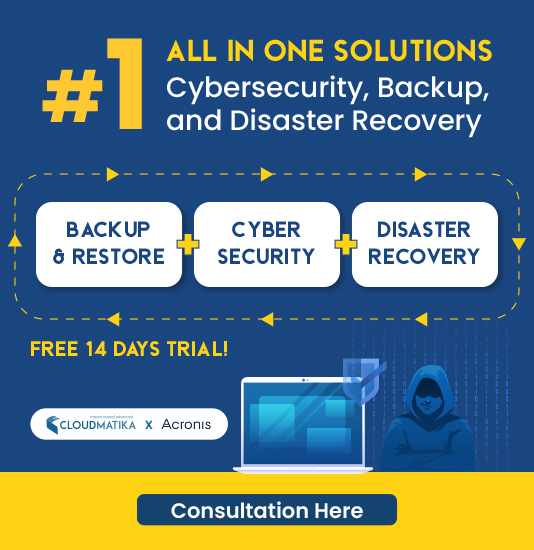
In the context of real-world implementation, Cloudmatika’s Disaster Recovery service is designed to be the foundation for fast and integrated system recovery. This service not only stores data backups but also enables comprehensive IT infrastructure recovery in the event of a disruption.
Through cloud-based replication and failover mechanisms, companies can quickly activate backup systems so that services continue to run without prolonged downtime.
Fast Recovery with Automatic Failover
Automatic failover allows backup servers to take over operations when the main system experiences a disruption. This process helps keep business applications active and reduces the risk of losing important transactions.
Flexibility for Various Infrastructures
Cloudmatika’s Disaster Recovery service is designed to be compatible with various IT environments, including both virtual machines and physical servers. This makes it easy for companies to implement DRP without having to change their existing architecture.
Local Data Centers for Optimal Performance
The existence of local data centers helps speed up the data replication and recovery process. Lower latency makes the recovery process more efficient while supporting security and compliance requirements.
If your business is starting to face challenges such as downtime or the risk of data loss, using cloud-based disaster recovery services can be a strategic move. Cloudmatika helps companies manage backups, replication, and system recovery in a single integrated ecosystem, enabling more optimal business continuity.
Benefits of Implementing Cloudmatika Disaster Recovery for Businesses
Integrating Disaster Recovery services into your BCP and DRP strategies provides a number of tangible benefits for companies:
- Accelerates system recovery time after a disruption
- Reduces backup hardware investment costs
- Provides flexibility to scale as needed
- Provides continuous monitoring and data protection
In addition, the managed service approach helps companies that do not have a dedicated IT team to continue to implement their disaster recovery strategy professionally.
Read also: Cybercrime Cases in Indonesia: Challenges, Data Leaks, and Digital Protection Efforts
First Steps in Building an Effective BCP and DRP Strategy
For optimal implementation, companies can start with the following steps:
- Identify the most critical systems and data
- Determine recovery time objectives (RTO) and recovery point objectives (RPO)
- Use cloud solutions for automatic backup and replication
- Conduct regular recovery testing
- Choose a technology partner with professional infrastructure and support
This approach helps businesses build a business continuity system that is better prepared to face various digital risks.
BCP and DRP are no longer just additional strategies, but a key requirement for companies that want to maintain operational stability in the modern era. With the support of cloud technology, the backup and system recovery process can be carried out more quickly, efficiently, and securely.
Through Cloudmatika’s Disaster Recovery service, companies can comprehensively integrate their business continuity strategy, from data protection to IT infrastructure recovery. With a flexible and scalable approach, your business can continue to run even when faced with unexpected disruptions.
Consult your BCP and DRP needs with Cloudmatika to find solutions that suit your company’s operational needs.


 Cloudmatika / April 2, 2026
 Cloudmatika / March 30, 2026
 Cloudmatika / March 30, 2026
 Cloudmatika / March 27, 2026
 Cloudmatika / March 26, 2026